Luxembourg, Dublin or Elsewhere? How Global Fund Managers Choose an EU Domicile After AIFMD II
One market, two dominant addresses
Europe’s investment funds held EUR 23.4 trillion in net assets at the end of 2024, and almost half of that sat in just two countries. Luxembourg accounted for 25% and Ireland for 21%, according to EFAMA’s 2025 Fact Book. Germany (12%), France (11%) and the Netherlands (4%) complete a top five that holds around 78% of the market. Both leaders have grown since: Luxembourg’s regulated funds reached EUR 6.69 trillion by 31 July 2026, and Irish-domiciled funds EUR 5.31 trillion by Q3 2025.
That concentration is not an accident of history. The EU regulates fund products and fund managers at European level, but each fund still needs a legal home in one Member State, and those homes compete on speed, legal flexibility, tax neutrality and service depth. 2026 has sharpened that competition. AIFMD II became applicable on 16 April 2026, ELTIF 2.0 is in its first full boom cycle, and the Commission’s December 2025 market integration package promises to erode some of the frictions that kept smaller domiciles small.
This article maps the full EU toolkit, then focuses on the alternative investment fund (AIF) regime and the jurisdictions where AIFs are easiest and most commonly structured. For each, it sets out the vehicles in use, who uses them, and a real example.
The EU fund toolkit: two frameworks, four labels, many national wrappers
Every EU fund falls on one side of a single line. It is either a UCITS, harmonised for retail investors, or an AIF, which is everything else. On top of that split, the EU has built four optional product labels that give specific strategies a passport, and each Member State offers its own legal wrappers in which any of these can live.
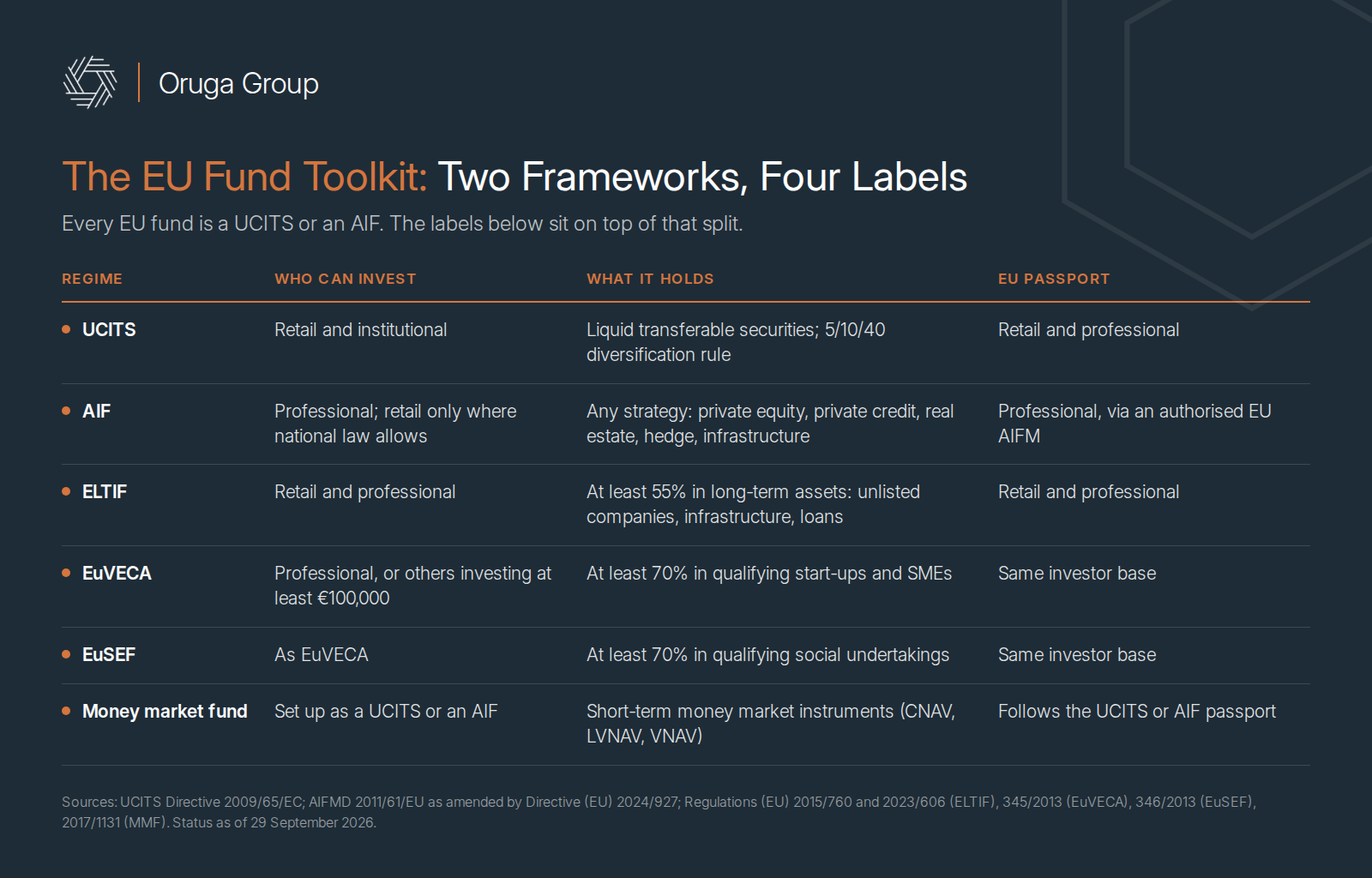
The EU fund toolkit: UCITS, AIF, ELTIF, EuVECA, EuSEF and money market funds compared by eligible investors, permitted assets and EU passport
The legal bases are the UCITS Directive (2009/65/EC), AIFMD (2011/61/EU, amended by Directive (EU) 2024/927 as AIFMD II), and the ELTIF (2015/760, amended by 2023/606), EuVECA (345/2013), EuSEF (346/2013) and Money Market Fund (2017/1131) Regulations.
Two points in the overview matter most for structuring. First, AIFMD regulates the manager, not the fund. The fund itself may be fully regulated, lightly regulated or unregulated at national level, as long as an authorised AIFM runs it. That is what makes Luxembourg’s RAIF or Malta’s Notified AIF possible. Second, ELTIF, EuVECA and EuSEF are labels layered on top of an AIF, not separate legal forms. An ELTIF is always an AIF, legally housed in a national wrapper such as a Luxembourg SICAV or an Irish ICAV.
The national wrappers are where jurisdictions compete. The main families are:
- Corporate vehicles with variable or fixed capital, such as the Luxembourg SICAV/SICAF, Irish ICAV and plc, German InvAG, Cypriot VCIC and Maltese SICAV.
- Contractual funds with no legal personality, such as the Luxembourg FCP, Irish unit trust and CCF, German Sondervermögen and Dutch FGR.
- Limited partnerships, the private-markets standard: the Luxembourg SCS and SCSp, Irish ILP, Dutch CV, German InvKG, French SLP and Cypriot LP.
AIFs after AIFMD II: what changed on 16 April 2026
AIFs are the workhorse of European private markets. At the end of 2024 they held EUR 8.2 trillion, against EUR 15.3 trillion in UCITS (EFAMA). Private equity, private credit, real estate, infrastructure and hedge strategies all sit here, and so do most of the sovereign wealth, pension and insurance mandates that Gulf and Asian capital deploys into Europe.
The rulebook for those funds changed this year. Directive (EU) 2024/927, known as AIFMD II, had to be transposed by 16 April 2026. Luxembourg did so through its law of 3 March 2026, which applies from 16 April 2026. Ireland followed with S.I. No. 181 of 2026, effective 1 May 2026. Enhanced supervisory reporting follows on 16 April 2027 in both.
Loan origination now has a single EU rulebook. Until this year, whether a fund could lend directly depended on the domicile. Ireland, for example, required loan-originating QIAIFs to be closed-ended and capped their gross assets at 200% of NAV. AIFMD II replaces this patchwork with harmonised rules:
- Leverage is capped at 175% of NAV for open-ended and 300% for closed-ended loan-originating AIFs, on the commitment method.
- Exposure to any single borrower is limited to 20% of capital where the borrower is a financial undertaking, another AIF or a UCITS, with a ramp-up period of up to 24 months.
- A fund that originates and then transfers a loan must retain 5% of its notional value, for eight years or until maturity if shorter.
- Loan-originating funds are closed-ended by default. Open-ended structures are allowed if the manager shows that liquidity management is compatible with the strategy.
- Funds set up before 15 April 2024 that raise no new capital are grandfathered. Those that raise new capital have until 16 April 2029 to comply.
- Member States may ban lending to consumers. Luxembourg has done so.
Liquidity management tools are mandatory. Every open-ended AIF must now select at least two tools from a harmonized EU list, such as redemption gates, notice periods, swing pricing or anti-dilution levies, and document how they are activated. Ireland’s Central Bank recommends that one be quantity-based and one an anti-dilution tool.
Delegation is more transparent, not more restricted. The core delegation model survives, which matters for sponsors who run portfolio management from London, New York, Dubai or Hong Kong. The price is more detailed reporting on delegated functions to the home regulator.
Non-EU managers face tighter gateways. Managers outside the EU that market through national private placement regimes must now meet stricter conditions tied to their home country. That country must not be on the EU’s high-risk AML list or its list of non-cooperative tax jurisdictions, and it must have signed an OECD-standard agreement on exchanging tax information. For Chinese and Gulf managers without an EU AIFM, this is a direct compliance question before any European fundraising.
How to pick a domicile: six questions that decide it
Since the passport is EU-wide, the choice of domicile rarely turns on market access alone. In practice, six questions decide it:
- Who are the investors? Institutional limited partners expect a familiar partnership. Wealth platforms need a retail-capable wrapper such as an ELTIF or a Part II fund. US taxable investors need a vehicle that can “check the box”.
- How fast must it launch? A Luxembourg RAIF or Malta Notified AIF avoids fund-level approval. An Irish QIAIF gets approved by close of business the day after filing. A Cyprus RAIF is registered in about one month.
- Does it need to be tax-transparent? Partnerships (SCSp, ILP, CV, InvKG) let treaty-sensitive investors look through to the underlying assets. Corporate funds offer a single, tax-neutral entity.
- Where will it be sold? Luxembourg and Ireland dominate cross-border distribution, holding roughly 48% and 43% of global cross-border fund assets respectively (Ocorian, 2026).
- What does the service ecosystem look like? Depositaries, administrators, auditors and independent directors must exist at scale, and at a competitive cost.
- Where will the manager sit? Carried interest taxation and substance rules for the general partner and AIFM often drive the decision as much as fund-level tax.
The product mix shows how these answers cluster. Ireland is the default for ETFs, with 75% of the European ETF market (Irish Funds, 2026). Luxembourg leads in cross-border UCITS and private-markets vehicles, and in ELTIFs: 151 of the 268 ELTIFs authorized by end-2025 were Luxembourg funds, managing EUR 22.0 billion of the market’s EUR 34.0 billion (Scope, April 2026). France is a distant second with 71.
Luxembourg: the toolbox jurisdiction
Luxembourg’s advantage is range. With EUR 6.69 trillion in 2,960 regulated funds and 13,256 fund units at 31 July 2026 (CSSF), it offers a vehicle for almost every combination of investor, strategy and regulatory appetite. It also keeps adjusting the toolbox. The law of 21 July 2023 cut the “well-informed investor” threshold from EUR 125,000 to EUR 100,000, extended the ramp-up period for SIFs, SICARs and RAIFs from 12 to 24 months, and exempted ELTIFs and money market funds from subscription tax. From 1 January 2025, actively managed ETFs were also exempted.
The main vehicles, and who typically chooses them:
- UCITS (Part I, 2010 Law): CSSF-approved and open to retail investors. The standard for global managers distributing liquid funds across Europe, Asia and Latin America.
- Part II UCI: CSSF-approved and retail-capable. Used by alternative managers for semi-liquid private-wealth products.
- SIF (2007 Law): CSSF-approved, for well-informed investors (EUR 100,000+). Suits institutions whose internal rules require a supervised fund.
- SICAR (2004 Law): CSSF-approved, for well-informed investors. Built for private equity and venture capital investing in risk capital.
- RAIF (2016 Law): no CSSF approval; supervised through its authorised AIFM. For sponsors that want a fund-regime vehicle without waiting for approval.
- SCSp (2013): an unregulated limited partnership unless wrapped as a RAIF or SIF. The standard GP–LP vehicle for private equity, venture, real estate and infrastructure.
- ELTIF: a CSSF-authorised label that can sit on any of these wrappers. Used by private-markets managers raising from European wealth clients.
Why the RAIF and the SCSp dominate private markets. Most Luxembourg private-markets funds combine the two. An SCSp gives institutional limited partners the Anglo-Saxon partnership they know: tax-transparent, no legal personality, and governed almost entirely by the limited partnership agreement. Wrapped as a RAIF, the same partnership can use umbrella compartments and fund-regime tax treatment, and it can launch without CSSF approval because an authorised AIFM is responsible for it. RAIFs pay a 0.01% annual subscription tax, or can opt for a SICAR-style regime if they invest in risk capital (Elvinger Hoss, May 2026).
Manager-side reform. Luxembourg’s parliament voted Bill No. 8590 on 22 January 2026. The second constitutional vote was waived on 3 February 2026, and the regime applies to income realised from 1 January 2026. It creates two tracks:
- Contractual carry, paid without any investment in the fund, is taxed as extraordinary income at a quarter of the individual’s progressive rate. That is a maximum effective burden of about 11.45%, including the solidarity surcharge. Only people in investment functions such as portfolio or risk management qualify, not administrative staff.
- Carry earned through an investment in the fund is exempt to the extent it reflects the fund’s outperformance. The stake must have been held for at least six months and be below 10% of the fund.
The law also drops the old requirement that investors recover their capital before carry is paid, so deal-by-deal waterfalls now fit the regime. It applies whatever the fund’s domicile, which makes Luxembourg a more credible base for investment teams as well as for funds.
Case examples
Blackstone Private Equity Strategies Fund SICAV (BXPE) is a Luxembourg Part II SICAV for non-US private-wealth investors. Minimums start at EUR 25,000 in some share classes, with periodic subscriptions and redemptions. It shows the Part II fund’s typical use: an evergreen private-equity product sold through wealth platforms that a closed-ended SCSp could not reach.
Apollo received CSSF authorisation on 24 September 2025 for three evergreen, semi-liquid ELTIFs under its Luxembourg Apollo Private Markets Umbrella SICAV. They cover European private credit, global diversified credit and global private markets, and target wealth investors in Europe, Asia and Latin America.
EQT launched EQT Nexus ELTIF Private Equity in Luxembourg on 15 September 2025, distributed through private banks and wealth platforms from November 2025 to non-professional investors across the EU and EEA. In April 2026 it added an infrastructure ELTIF drawing on a platform with EUR 78 billion of assets under management. The platform’s closed-ended infrastructure funds had until then been sold to institutional investors.
Ireland: the ETF and corporate-fund powerhouse
Ireland’s strength is scale in liquid products and speed in alternatives. At the end of Q3 2025 it hosted 9,254 funds (5,818 UCITS and 3,436 AIFs, counting sub-funds) with EUR 5.309 trillion in net assets, up 13.5% on the year. It holds 75% of the European ETF market and distributes funds to more than 90 countries. Its policy agenda, the government’s Funds Sector 2030 review, is openly aimed at growing private-asset funds, and the revised Central Bank AIF Rulebook, published on 5 May 2026 alongside AIFMD II transposition, delivers part of it.
The main vehicles, and who typically chooses them:
- ICAV (2015): a corporate vehicle built for funds, with segregated umbrella sub-funds and the option to “check the box” for US tax. The default for ETF issuers, UCITS managers and QIAIF sponsors with US or global investors.
- Investment company (plc): the traditional corporate fund, still home to many ETF and UCITS ranges set up before the ICAV existed.
- ILP (2020 amendments): a tax-transparent limited partnership, open- or closed-ended. Used for private equity, private credit, real estate and infrastructure GP–LP funds.
- CCF: a tax-transparent contractual fund closed to individual investors. Used to pool pension and institutional assets where treaty access matters.
- Unit trust: a trust-based contractual fund used for legacy retail ranges and some institutional mandates.
The corporate and contractual wrappers can be authorised as a UCITS, a Retail Investor AIF (RIAIF) or a Qualifying Investor AIF (QIAIF); the ILP is available only as an AIF. The QIAIF is Ireland’s main alternatives product. It requires a EUR 100,000 minimum subscription from qualifying investors, has no Central Bank investment or borrowing limits beyond AIFMD II’s loan-origination rules, and is approved on a fast-track basis by close of business on the day after filing.
Tax. Irish funds pay no tax on income or gains, no subscription tax and no stamp duty on unit transfers. Non-resident investors are paid gross on a non-residence declaration. For Irish resident individuals, Finance Act 2025 cut the exit tax from 41% to 38% from 1 January 2026. It also introduced a dividend withholding tax exemption for distributions to ILPs holding at least 51% of a company. Most regulated Irish funds are “excluded entities” under Pillar Two.
Case examples
- iShares Core S&P 500 UCITS ETF (USD, Acc) is an Irish-domiciled investment company fund launched on 19 May 2010, with about EUR 137 billion in assets and a 0.07% TER (justETF, September 2026). It shows why Ireland dominates ETFs. The corporate UCITS wrapper lists on several European exchanges at once, and Irish domicile gives access to the US–Ireland tax treaty on US dividends. Its buyers are European retail investors, wealth managers and institutions.
- ARK Private Innovation ELTIF, a sub-fund of ARK ELTIF ICAV, was authorised on 22 December 2025. Its AIFM is IQ-EQ Fund Management (Ireland) and its investment manager is ARK Investment Management in the US. It targets 75–85% in private companies and offers quarterly redemptions of up to 5% of NAV after a ramp-up period. It shows a US manager using an Irish ICAV, a third-party AIFM and the ELTIF label to reach retail and professional investors in more than 18 European countries without building its own EU management company.
The challengers: niche strengths, not all-rounders
Outside the two hubs, each serious domicile wins on something specific: a domestic investor base, a particular vehicle, speed, or cost.
Netherlands: the CV and FGR, reset in 2025. The Netherlands held EUR 0.90 trillion in fund assets at end-2024 (EFAMA). Its private-markets toolkit is the limited partnership (CV) and the fund for joint account (FGR). From 1 January 2025, CVs and foreign LPs are generally treated as tax-transparent. An FGR is now opaque only if it qualifies as a regulated investment fund or UCITS whose units are truly transferable. Units redeemable only by the fund itself do not count. Existing structures had until the end of 2025 to amend their documents (CMS). The result is simpler, more predictable classification for Dutch LPs used by institutional and pension investors.
Germany: the Spezial-AIF for German institutions. Germany (12% of European fund assets) is largely a domestic market. Its signature product is the Spezial-AIF under the Investment Code (KAGB), set up as a Sondervermögen, an investment limited partnership (InvKG) or an investment stock corporation (InvAG). It may only be sold to professional investors and to “semi-professional” investors committing at least EUR 200,000. It needs a BaFin notification rather than product approval. German insurers, pension schemes and professional pension funds (Versorgungswerke) are its core buyers.
France: the SLP and the ELTIF retail channel. France (11% of European fund assets) introduced the société de libre partenariat (SLP) in 2015 as its answer to the Anglo-Saxon LP, and it is now standard for French private equity. France is also Europe’s largest ELTIF market by investor: French investors held EUR 14.1 billion, or 41.4% of ELTIF assets, at end-2025. The AMF has authorised 71 ELTIFs (Scope, April 2026).
Cyprus: speed and cost for smaller managers. A Cyprus Registered AIF (RAIF) is registered with CySEC in about one month and is open to professional and well-informed investors. It must have an external AIFM. Its tax reform, voted on 22 December 2025 and published on 31 December 2025, took effect on 1 January 2026. It raised corporate tax from 12.5% to 15%, cut the special defence contribution on dividends to individuals from 17% to 5%, and abolished deemed dividend distribution for profits earned from 2026. Limited partnerships remain tax-transparent, and gains on securities stay largely outside capital gains tax. The exception is “property-rich” shares, whose threshold fell from 50% to 20% of value derived from Cyprus real estate. Employees of fund managers can still elect an 8% flat rate on variable pay linked to carried interest, for up to ten years and with a minimum tax of EUR 10,000 a year. PwC’s summary, last reviewed in August 2026, shows this regime unchanged by the reform. Its investor base is mainly international, including capital from the Middle East and Israel (Chambers, 2026).
Malta: the Notified AIF. A Malta Notified AIF (NAIF) is listed by the MFSA within about ten working days of a complete filing, with no licensing process. Due diligence and ongoing oversight fall to its full-scope AIFM. It is open to professional and qualifying investors (EUR 100,000 minimum). Loan funds and funds investing mainly in non-financial assets such as real estate cannot use it (CSB Group). That makes it a fast option for liquid and securities strategies, not for private credit or property.
Side by side: the fast-track AIF vehicle in each domicile
The chart compares each jurisdiction’s quickest route to a professional-investor AIF, together with its main partnership vehicle.
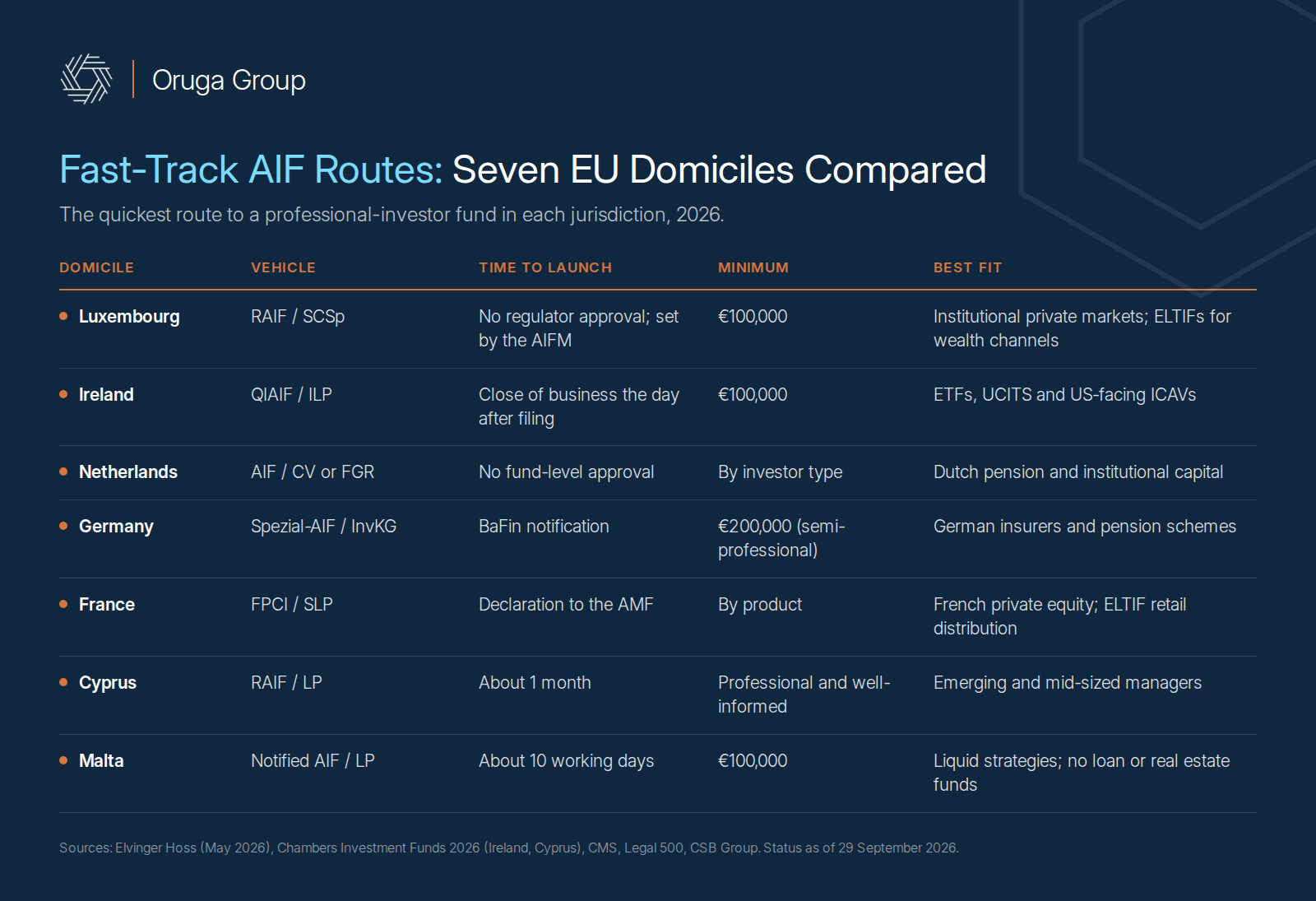
Fast-track AIF routes in seven EU domiciles: Luxembourg, Ireland, Netherlands, Germany, France, Cyprus and Malta compared by vehicle, time to launch, minimum investment and best fit
Beyond the wrapper: five issues that shape the structure in 2026
Substance still matters, even without “Unshell”. The EU’s proposed Unshell Directive (ATAD 3) was abandoned on 20 June 2025 (ATOZ). That did not end substance scrutiny. Treaty access, the anti-hybrid rules in ATAD, and domestic anti-abuse doctrines still require fund holding companies and general partners to have real decision-making, directors and records where they are resident. Pillar Two’s 15% minimum tax generally excludes regulated investment funds, but holding companies below them need case-by-case analysis.
SFDR 2.0 will change fund labels. The Commission’s proposal of 20 November 2025 replaces the familiar Article 8 and Article 9 disclosures with three voluntary categories: “Sustainable”, “Transition” and “ESG Basics”. Each requires at least 70% of the portfolio to support the stated strategy. The Council adopted its negotiating mandate on 24 June 2026 and proposes a 24-month application period. As of September 2026, the Parliament’s ECON committee has not yet voted, so trilogues have not started (Proskauer, August 2026). Sponsors launching now should draft documents that can migrate to the new categories.
The market integration package could narrow the gap between domiciles. On 4 December 2025 the Commission proposed measures that would stop host Member States adding their own marketing-communication rules or prior-notification requirements. It also proposed an EU depositary passport, which would allow a fund to appoint a depositary in another Member State, and annual ESMA reviews of how national regulators supervise asset-management groups with over EUR 300 billion across several Member States. These proposals are still in the legislative process. Phased application is not expected before mid-2027 (A&L Goodbody).
Tokenization happens inside fund law, not MiCA. Units of UCITS and AIFs are financial instruments and therefore outside the Markets in Crypto-Assets Regulation. A tokenized fund remains a UCITS or AIF, with the domicile’s fund rules, depositary requirements and AIFMD II obligations intact. Distributed-ledger share registers and settlement are developing under national law and the EU DLT Pilot Regime, not under a crypto license.
Poland: a domestic option with limits. Polish sponsors can use the alternative investment company (ASI) regime supervised by the KNF. Managers below EUR 100 million in assets (EUR 500 million for unleveraged, closed-ended strategies) need only registration. Above those thresholds they need a full license. Registration alone typically takes five to nine months. For cross-border fundraising from non-EU investors, one option is a Luxembourg or Irish fund investing through a Polish holding company. That pairs a wrapper international investors already know with a local operating structure.
What this means for non-EU sponsors
The case examples share a pattern. Blackstone, Apollo and EQT used Luxembourg wrappers. ARK used an Irish ICAV and a third-party AIFM. None built an EU presence from scratch. Each chose a domicile its target investors already trusted, placed the product under an authorised EU AIFM, and picked the label (Part II, ELTIF, UCITS) that matched the investors it wanted to reach. For a sponsor based in the US, UK, Switzerland, Asia or the Gulf, that points to four practical conclusions.
- Decide the manager route before the fund. Since 16 April 2026, private placement under AIFMD II depends on the sponsor’s home country meeting EU AML, tax-cooperation and information-exchange tests. Where it does not, or where the sponsor wants the passport, the realistic options are a third-party (“host”) AIFM, as ARK used, or an EU AIFM of the sponsor’s own.
- Let the investor base pick the domicile. Institutional limited partners point to an SCSp-RAIF or an ILP-QIAIF. European wealth money points to a Luxembourg ELTIF or Part II fund, where 151 of 268 ELTIFs already sit. ETF and liquid-strategy distribution points to an Irish ICAV.
- Treat speed as a structuring choice. A RAIF, a QIAIF, a Cyprus RAIF and a Malta NAIF all compress time to market, but each carries conditions on manager, investor type or strategy. A NAIF, for example, cannot hold loans or real estate.
- Plan substance and people together. The end of Unshell did not end substance tests, and manager-side regimes such as Luxembourg’s 2026 carried interest reform now influence where investment teams sit.
This article is for general information purposes only and does not constitute legal, financial, or investment advice. Information is current as of 29 September 2026.