Europe's M&A Market in 2025-2026
Fewer Deals, Larger Checks, and a Regulatory Landscape That Has Changed the Game
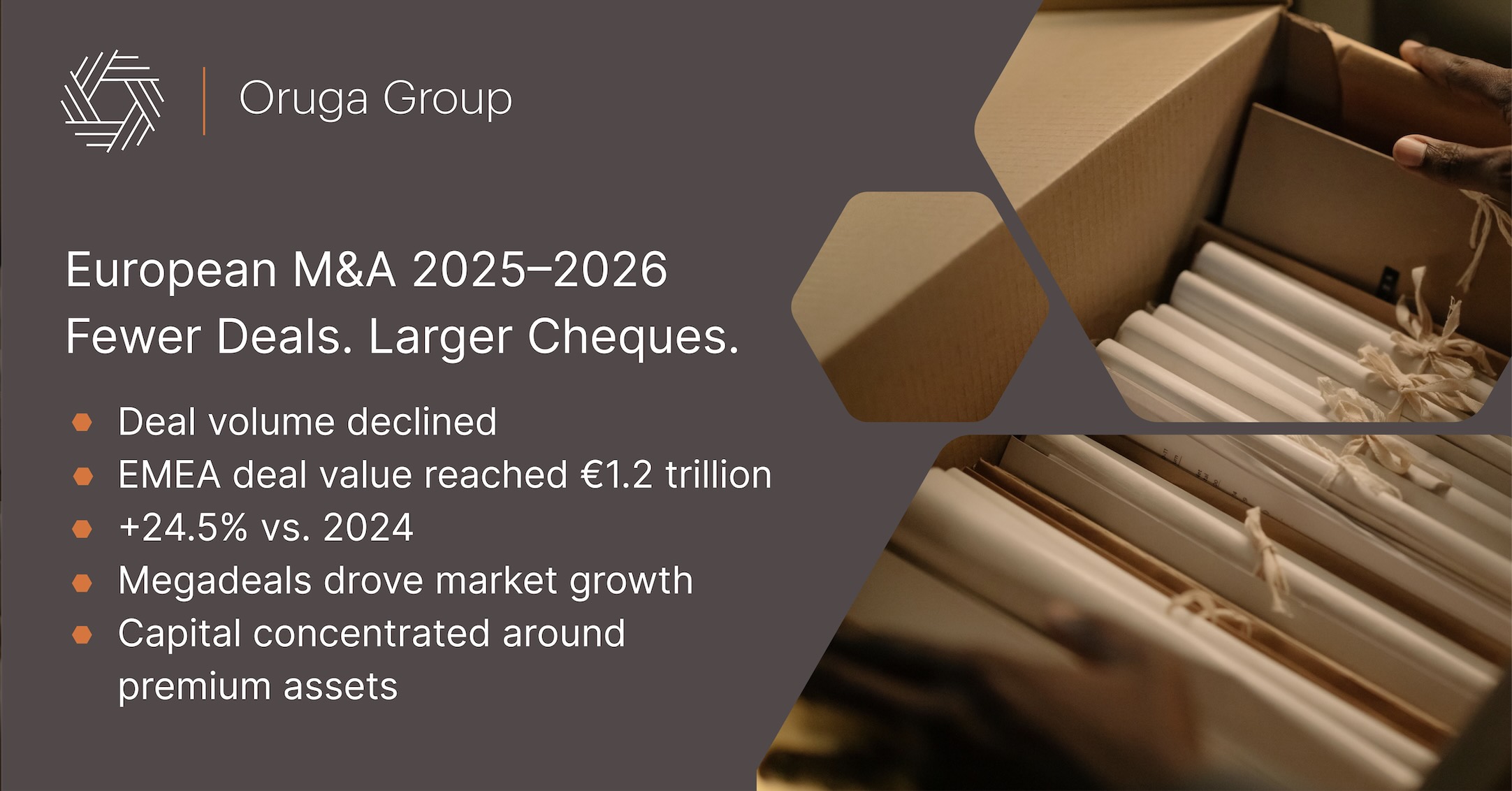
The most misleading thing about the European M&A market in 2025 is its headline deal count. Volume fell. Aggregate transaction numbers across the EU and EEA declined in the first half of the year, and observers conditioned by the 2021 boom interpreted the numbers as evidence of continuing hesitation. They were reading the wrong metric. By year-end, aggregate deal value across EMEA reached approximately €1.2 trillion, a 24.5% increase on 2024, driven by a decisive acceleration in the second half that erased the cautious first half almost entirely. The market did not slow down. It's concentrated.
Five structural forces explain that concentration: the dominance of large-cap and megadeal activity over mid-market volume; a historic year for banking consolidation; a step-change in defense and dual-use M&A; artificial intelligence as both strategic rationale and due diligence workstream; and a regulatory architecture, the EU Merger Regulation, the Foreign Subsidies Regulation, and 25 national FDI screening regimes operating simultaneously, that has added measurable cost and timeline to every material cross-border transaction.
What European M&A means, and why the aggregate figures require careful reading
European M&A, for the purposes of this analysis, refers to merger and acquisition transactions in which at least one party is established or operating in the European Union or the European Economic Area. Most major data providers, Mergermarket, Dealogic, Datasite, report on an EMEA basis, which overstates pure EU/EEA activity while understating the significance of UK-linked flows that persist despite the UK's departure from the EU single market. This distinction matters because the regulatory frameworks governing a transaction apply on EU/EEA parameters, not EMEA ones. Understanding which regime applies, and at what threshold, is now a fundamental deal-structuring question before any other analysis begins.
The K-shaped market: why fewer deals produced more value
H1 2025 produced approximately $416 billion in total EU deal value across 6,634 transactions, a 2.6% decline in value and an 18.1% decline in volume against H1 2024. That description of restraint is technically accurate and analytically incomplete. The compression occurred almost entirely in the mid-market and small-cap segments, where valuation gaps between buyers and sellers persisted despite the ECB's continued rate-cutting program. Strategic buyers with clear industrial logic, however, remained willing to pay substantial premiums for premium assets, and the top EMEA megadeals numbered 20 in 2025 against 12 in 2024, a disproportionate contribution to aggregate value growth.
H2 2025 resolved the ambiguity. Germany alone saw M&A deal value rise 167% between its first and second halves, driven by constitutional reforms authorizing substantially higher defense expenditure and renewed strategic buyer confidence. By year-end, Europe's aggregate M&A market had posted what analysts characterized as one of its strongest performance periods since the pre-financial crisis era. The financing picture was correspondingly bifurcated: all-cash structures dominated strategic transactions in financial services and defense, while private credit, now accounting for approximately 20% of total deal financing globally, served mid-market transactions alongside traditional bank lending. Global leveraged finance issue reached $1.3 trillion in 2025, up 45% year-on-year.
Banking consolidation: a record year, and a more complex story
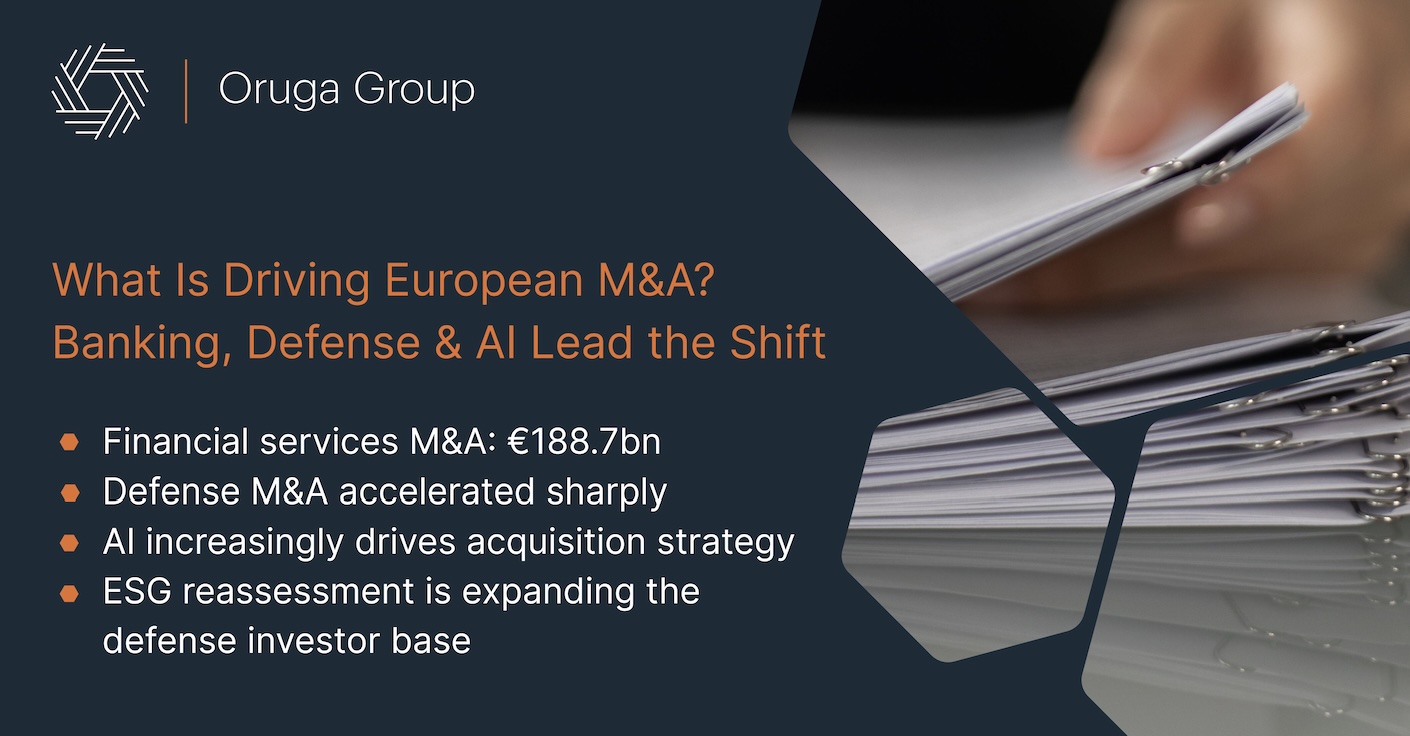
Financial services was the defining sector of 2025 by deal value. EMEA financial services M&A reached €188.7 billion, an 81.6% year-on-year increase across 1,523 deals, and Italy alone accounted for more than €30 billion in banking transaction value. The strategic rationale was coherent: scale imperatives driven by rising technology and compliance costs, the hunt for fee income diversification as the rate cycle turned, and the structural opportunity created by the EU's incomplete Banking Union.
Three headline transactions tell three different stories about what cross-border banking consolidation actually looks like in practice. Banca Monte dei Paschi di Siena's €16.5 billion acquisition of Mediobanca, creating Italy's third-largest financial institution, proceeded with government support and illustrated when Italy's Golden Power framework permits consolidation. BBVA's €16.3 billion hostile bid for Banco Sabadell failed after the Spanish government required Sabadell to be maintained as a separate legal entity for three to five years post-merger; shareholders voted the offer down as inadequate on those terms. And UniCredit's pursuit of Commerzbank, launched as a formal voluntary exchange offer on March 14, 2026 at an implied price of €30.8 per share, was immediately rejected by Commerzbank's board as insufficiently priced, with the German Finance Ministry having already declared hostile takeovers of systemically important banks unacceptable. Settlement is not expected before H1 2027. Together, these three transactions map the terrain: the economic logic of consolidation is clear, the political logic of preservation is equally clear, and the two are structurally in conflict across every major EU banking jurisdiction.
Defense, technology, and the AI premium
European defense M&A deal value reached $2.3 billion in H1 2025 alone, a 35% year-on-year increase, and accelerated further in H2. The STOXX Europe Defense index gained over 65% during 2025. These are not cyclical numbers. They reflect a structural reallocation of capital driven by NATO spending commitments, Germany's constitutional fiscal reform authorizing defense expenditure projected to exceed €150 billion per year by 2029, and the EU defense fund's expansion. Rheinmetall's $950 million acquisition of Loc Performance Products, Safran's €220 million acquisition of AI-for-defense company Preligens, and Helsing's €600 million Series D fundraise collectively illustrate both vectors of the defense M&A wave: physical capability acquisition and AI integration. Institutional investor ESG screens, previously excluding defense assets, are undergoing active reassessment, a shift that has expanded the buyer universe materially.
Technology, media, and telecommunications produced €252.1 billion in EMEA M&A value across 3,872 deals in 2025, with Q4 alone generating €89.9 billion. Approximately one-third of the 100 largest corporate M&A transactions of 2025 cited artificial intelligence as part of their strategic rationale. AI is reshaping not only why deals are done, acquisition capability, data asset consolidation, defensible moat construction, but how due diligence is conducted. Training data provenance, model performance verification, and open-source license compliance are now standard workstreams in technology M&A. For AI-specific assets, buyers increasingly require earn-out structures to validate revenue projections that cannot be confirmed at signing, and technical performance benchmarks alongside financial metrics are becoming market standard in earn-out design.
Three regulatory frameworks, operating simultaneously
The regulatory environment for cross-border European M&A has changed more substantially in the past three years than in the preceding two decades. Transactions of any material scale now engage three frameworks simultaneously: the EU Merger Regulation, the Foreign Subsidies Regulation, and national FDI screening mechanisms across up to 25 EU member states.
The FSR, fully applicable since July 2023, had generated more than 200 M&A notifications by mid-October 2025, well above the 30 per year initially forecast. Two Phase II cases have been resolved with remedies: e&/PPF Telecom Group and ADNOC/Covestro. The ADNOC/Covestro clearance of November 2025 required ADNOC to make Covestro's sustainability-related patents available to market participants, a remedy that arguably imports sustainability policy considerations into FSR analysis for the first time. Notably, 47% of FSR notifying parties are EU-based investors, reflecting the regulation's deliberately broad design: it captures far more than state-linked non-EU acquirers. The penalty for gun-jumping is up to 10% of global annual turnover, and the FSR is suspensory, closing before FSR clearance is obtained constitutes a structural breach, regardless of EUMR timeline.
The FDI landscape has reached near-universal coverage. Ireland's FDI Screening Act entered into force in January 2025, Greece enacted its framework in May 2025, and Bulgaria's regime commenced in July 2025. The provisional agreement on a revised EU FDI Regulation, reached December 11, 2025, will mandate harmonized minimum screening across all 27 member states when it enters into force, expected around 2027. For transactions in sensitive sectors, defense, semiconductors, artificial intelligence, critical infrastructure, simultaneous engagement with multiple national authorities is now the operating baseline, not the exception.
Advising cross-border transactions in the current environment
Practical advice for parties structuring European M&A must begin with regulatory mapping rather than tax or valuation analysis. The sequence matters: identifying which regulatory regimes apply, and in which order they are likely to clear, conditions of the deal timeline, the signing mechanics, and the risk allocation between buyer and seller. Where the FSR and EUMR apply in parallel, the possibility of misaligned review timelines must be addressed in the transaction agreement. Long-stop dates and reverse break fees should be modeled against the FSR Phase II track, currently up to 90 working days, not only the EUMR. For transactions involving non-EU acquirers, the FSR's broad definition of foreign financial contributions requires early analysis of the acquirer's full group subsidy history, not merely the acquiring entity. CEE markets, which posted historic highs in 2025 with 1,568 transactions and €36.64 billion in aggregate deal value, warrant particular attention: FDI screening regimes in Poland, Romania, and Czechia have tightened, and GTCR's €4.1 billion acquisition of Zentiva and CVC's €1.3 billion healthcare consolidation transaction both required multi-jurisdictional regulatory co-ordination.
FAQ
1. Does a transaction require notification under both the EUMR and the FSR, and how are the timelines co-ordinated?
Yes, if both sets of thresholds are met, parallel notification is mandatory and neither regime creates a carve-out for the other. The EUMR threshold is met where parties have combined worldwide turnover above €5 billion and each of at least two parties has EU-wide turnover exceeding €250 million. The FSR is triggered where the target has EU turnover of at least €500 million and all parties combined have received at least €50 million in foreign financial contributions from non-EU states in the three preceding years, broadly defined to include grants, loans, guarantees, capital injections, and tax exemptions from any non-EU government entity. Both are suspensory: closing before either clearance is obtained constitutes gun-jumping, regardless of how far the other review has progressed. Deal teams should plan for independent Phase II tracks under each regime, map their potential interaction, and structure long-stop dates against the FSR timeline specifically.
2. What does the ADNOC/Covestro FSR decision mean for the deal risk analysis of state-linked non-EU acquirers?
The ADNOC/Covestro conditional clearance of November 2025, the first FSR Phase II case resolved with remedies, established that the Commission will impose structural conditions on transactions it concludes distort the EU internal market through foreign subsidization. The remedy requiring market access to sustainability-related patents is particularly significant: it suggests the Commission may incorporate innovation and sustainability policy objectives into FSR remedy design, beyond a purely market-distortion framework. Non-EU acquirers with material subsidy histories, particularly state-owned enterprises and sovereign wealth fund-backed vehicles, should conduct pre-notification engagement with the Commission on a precautionary basis for any transaction approaching the FSR thresholds, and should model remedy risk, including patent access, licensing, and governance conditions, as part of transaction economics.
3. What are realistic timelines for a cross-border European banking M&A transaction subject to ECB, EUMR, and national FDI review?
The UniCredit/Commerzbank exchange offer, launched March 14, 2026, illustrates the operating range. Settlement is targeted for H1 2027 at the earliest, with ECB authorization for the stake increase having been granted in March 2025 and Bundeskartellamt approval still pending as of report date. For cross-border banking transactions requiring EUMR review, ECB supervisory clearance, and one or more national FDI approvals, eighteen to twenty-four months from signing to settlement is a realistic planning horizon for contested or politically sensitive transactions. Friendly transactions in jurisdictions with no material FDI complexity can close in eight to twelve months. Parties should not assume that ECB approval of a preliminary stake-building program constitutes any form of precedential clearance for the subsequent full transaction.
4. How should earn-out provisions be structured for AI-driven technology targets where revenue projections cannot be verified at signing?
Earn-out design for AI-specific assets should combine financial outputs, recurring revenue thresholds, EBITDA levels, with technical performance benchmarks: model accuracy at specified deployment volumes, deployment milestone completion dates, and customer adoption metrics that are objectively measurable rather than management-assessed. The earn-out period should not extend beyond three years; longer periods increase governance friction over post-close investment decisions that affect metric achievement. Anti-avoidance protections must prevent the buyer from restructuring revenue flows, redirecting key technical personnel, or withholding investment that would foreseeably affect earn-out performance. Independent accountant arbitration should be specified for metric disputes in the purchase agreement rather than left to ad hoc post-close.
5. Which EU member states operate the most intensive FDI screening regimes for transactions in technology, defense, and critical infrastructure?
Germany's AWV/AWED framework requires mandatory notification for acquisitions of 10% or more in critical sectors including defense, AI infrastructure, and semiconductors, and has demonstrated a willingness to oppose transactions at a political level, as the Finance Ministry's public position on UniCredit/Commerzbank made clear. France's Siiv regime is among the most proactively engaged in Europe, with Phase 2 reviews common where governance conditions or market-access remedies are anticipated. Italy's Golden Power framework blocked UniCredit's Banco BPM bid through conditions that caused the deal's economic logic to collapse from the seller's shareholders' perspective. The Netherlands has proposed extending its BTI regime to AI, biotechnology, and nanotechnology, with mandatory notification for minority stakes as low as 10% in those sectors. The revised EU FDI Regulation, once in force around 2027, will mandate coverage across all 27 member states, but national governments will retain final decision authority.
6. How does the Corporate Sustainability Reporting Directive affect M&A due diligence and transaction structuring for EU targets?
The CSRD is now operative for large EU-listed companies and expanding progressively through 2026. For M&A buyers, the practical effect is that non-compliant targets may carry material post-close reporting and remediation costs that must be modeled into the purchase price. ESG representations and warranties are increasingly standard in European purchase agreements, and W&I insurance is beginning to offer ESG-specific coverage, though known-matter exclusions remain standard. For defense-sector assets specifically, institutional investor ESG screens, previously excluding defense on categorical grounds, are under active reassessment in light of geopolitical realities, which has expanded the universe of credible buyers and improved competitive tension in auction processes. Buyers and sellers should not assume that ESG classifications applied to defense assets pre-2024 reflect current market treatment.
This article is for general information purposes only and does not constitute legal, financial, or investment advice. Nothing herein creates a client relationship or a duty of care. Readers should obtain qualified legal, regulatory, and financial advice specific to their circumstances and to the jurisdictions in which they are operating before taking any transactional or structural decisions.