Abu Dhabi's Two Playbooks: What ADNOC and Mubadala's European Deals Reveal About Gulf Capital in the EU
Two of the largest Gulf-backed acquisitions moving through the EU in 2025 and 2026 have almost nothing in common on paper. One is a state oil major buying a DAX-listed chemicals group. The other is a sovereign wealth fund's private equity arm buying a French holiday-park operator to take it off the stock market entirely. Different buyer, different sector, different country of the seller, different deal logic.
What they share is where they both end up: the European Commission's Foreign Subsidies Regulation (FSR) - a tool that did not exist in its current, teeth-baring form four years ago, and that both an Abu Dhabi state enterprise and an Abu Dhabi sovereign fund now have to plan around as a matter of course. Read side by side, the two deals show two different ways of managing the same risk: one negotiated its way through the FSR after the fact; the other is trying to engineer around the worst of the delay before it even files.
1. ADNOC/XRG and Covestro: negotiating your way through, after the fact
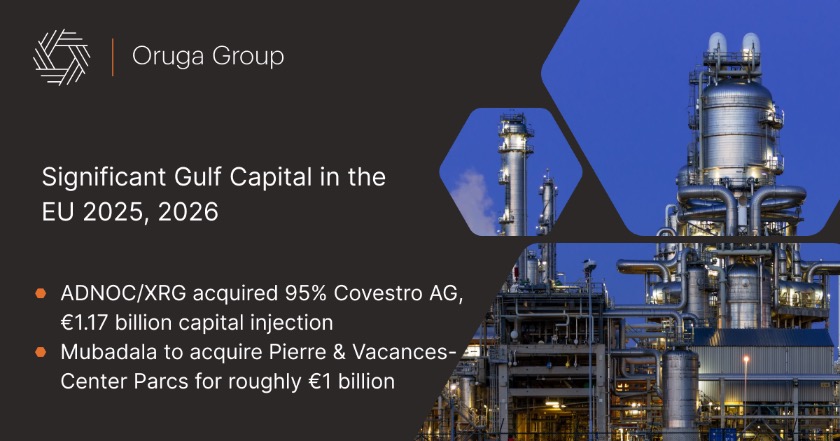
In 2025, Abu Dhabi National Oil Company (ADNOC), through its investment arm XRG, acquired roughly 95% of Covestro AG, one of Germany's largest chemicals manufacturers, at a headline price of €62 per share - an equity offer worth close to €12 billion on its own, rising toward the €15 billion figure widely cited for the transaction once ADNOC's committed €1.17 billion capital injection into the company is counted in. Either way, this is comfortably the largest Gulf acquisition of a European industrial company to date. EU merger control cleared the deal on competition grounds in May 2025, finding no overlap problem. That should have been the end of the regulatory story. It wasn't.
Because ADNOC is fully state-owned, the transaction was also notified under the FSR, and in July 2025 the Commission opened a full Phase II investigation - only the second time it has ever done so for a merger. The Commission's concern was not that ADNOC broke any rules; it was that ADNOC's position as a state enterprise came with advantages a private bidder could never match. Specifically, the Commission pointed to an implicit, never-formalised state guarantee (inferred partly from ADNOC's outsized role in the Abu Dhabi economy - roughly half of the emirate's GDP), a €1.17 billion capital injection ADNOC committed to make into Covestro as part of the deal, and preferential UAE and Singapore tax treatment. Even though the capital injection was ADNOC's own money, the Commission still treated it as a state subsidy, on the reasoning that ADNOC's ownership and governance made the distinction meaningless in practice - and that the premium ADNOC ultimately paid (around €62 per share) was itself evidence that a subsidised bidder had priced out unsubsidised rivals.
The deal cleared in November 2025, but only after ADNOC agreed to a package of remedies running for ten years: formally subjecting itself to ordinary UAE insolvency law rather than relying on any implicit state backstop, and - the more consequential commitment - opening Covestro's existing and future sustainability-related patents to market-rate licensing by EU competitors (with a short list of named exclusions), overseen by an independent monitoring trustee. Rather than force ADNOC to ring-fence Covestro financially from its parent, as the Commission's first-ever FSR merger decision had done to a different buyer, the remedy here spread the benefit across the EU chemicals sector instead - a materially different, more creative fix.
2. Mubadala Capital and Pierre & Vacances-Center Parcs: pre-committing your way around the delay
Mubadala Capital - the private equity arm of Abu Dhabi's Mubadala sovereign wealth fund - is taking a different EU asset in a different direction. In July 2026 it signed a tender offer agreement to acquire Pierre & Vacances-Center Parcs, the French operator behind Center Parcs, Sunparks, Adagio and Maeva, for roughly €1 billion, at €1.90 per share (€1.79 ex-distribution), with a further €0.10 per share payable if Mubadala successfully squeezes out remaining shareholders and delists the company from Euronext Paris.
Two things about the structure are worth noting. First, the sector: this is sovereign Gulf capital moving into consumer leisure and hospitality rather than the energy, chemicals, defence or infrastructure assets that usually dominate the Gulf-investment narrative - a reminder that “strategic” no longer means only heavy industry in the eyes of EU regulators, but also that not every Gulf deal triggers the same intensity of review. Second, and more instructive: before the tender offer agreement was even signed, Mubadala had already locked up commitments from shareholders holding more than 80% of the company's capital - including all three of its largest holders - to tender their shares. That is a deliberate sequencing choice. The company's own announcement is explicit that the deal remains subject to “customary regulatory approvals with respect to antitrust, foreign subsidies regulation and foreign direct investment in certain jurisdictions” - the same FSR gate ADNOC had to clear - with the formal offer not expected to launch until the first quarter of 2027 and closing pencilled in for the first half of 2027. By securing overwhelming shareholder support up front, Mubadala has taken deal-completion risk almost entirely off the table before the slower regulatory clock even starts running, leaving the FSR and FDI reviews as the only real variable left in the timeline.
What the two have in common
Both cases confirm the same underlying shift: for a Gulf state enterprise or sovereign-linked fund, the FSR is not a niche risk confined to heavy industry - it now applies with equal force to a chemicals major and a holiday-park operator, and both ADNOC and Mubadala built their deals assuming it would apply rather than hoping it wouldn't. But the two also show there is more than one legitimate response. ADNOC treated the FSR as a negotiation to be had once the Commission raised concerns, trading a decade of patent-licensing access for clearance. Mubadala is treating it as a known, unavoidable delay to be planned around from day one, front-loading shareholder certainty so that the eighteen-month regulatory tail is the only open question left by the time the formal offer launches.
For Gulf investors - and for advisers structuring Gulf entry into Poland and the wider EU - the practical takeaway is to stop treating the FSR as an add-on to antitrust and national FDI review, and start treating it as a third, independent workstream from the earliest planning stage: it has its own theory of harm (state advantage, not competitive overlap), its own remedies (which can be structural, behavioural, or both), and - as both of these deals show - its own clock, which now regularly runs longer than the antitrust review it sits alongside.
This article is for general information purposes only and does not constitute legal, financial, or investment advice. Nothing herein creates a client relationship or a duty of care. Readers should obtain qualified legal, regulatory, and financial advice specific to their circumstances and to the jurisdictions in which they are operating before taking any transactional or structural decisions.