2025-2026 Europe's Private Equity Record: Who Actually Won, and What Comes Next
European private equity delivered its strongest year on record in 2025, outperforming the prior 2021 peak in total deal value.
What the headline figure obscures is more useful than the figure itself: this was a market defined by concentration rather than breadth, by megadeal dominance rather than broad-based recovery, and by an LP base under sustained pressure to see capital returned through whichever exit route remained viable. Understanding what drove the record, and what it leaves unresolved, matters considerably more than citing it.
What European private equity is, and why the structure matters?
Private equity, at its most precise, refers to investment in companies through private rather than public markets, primarily through funds structured as limited partnerships in which institutional investors (limited partners) commit capital that the fund manager (general partner) deploys through acquisitions, growth financing, and operational transformation, with the objective of generating returns through eventual exit. In the European context, the asset class encompasses buyout strategies, growth equity, infrastructure, and private credit, though buyout by controlling interest remains the dominant strategy by capital deployed. The practical relevance extends well beyond fund managers and institutional investors: corporate management teams navigating take-private approaches, founders considering a PE-backed sale, family offices allocating to the asset class through ELTIF structures, and general counsel advising on FSR-notifiable cross-border transactions are all direct participants. The period from June 2025 through March 2026 represents the acceleration and consolidation phase of the most active European PE market in the asset class's modern history.
1. The macro forces that drove the year
Three structural forces created the conditions for the 2025 record, and understanding each is necessary to read the year accurately.
The first was the European Central Bank's rate cycle. With EUR base rates sitting approximately 230 basis points below equivalent US rates as of mid-2025, European leveraged finance was materially cheaper than its American counterpart. That differential directly supported buyout activity, particularly in H2 2025 when dealmaking accelerated sharply following a Q2 pause induced by the Trump administration's “Liberation Day” tariff announcements of April 2, 2025. The tariff shock produced a measurable contraction, PitchBook recorded European PE deal value falling 24.6% quarter-on-quarter in Q1 2025, but the freeze proved temporary. Activity revived sharply in the second half as trade tensions partially de-escalated and sponsors refocused on European assets whose predominantly domestic revenue footprints were insulated from direct tariff exposure. Deal count in Q3 2025 rose 36% year-on-year versus the same period in 2024.
The second structural force was the valuation gap between European and US listed equity. With the STOXX 600 trading at approximately 11x EBITDA and the S&P 500 at 16x, European listed companies represented a structurally attractive acquisition opportunity for US sponsors prepared to underwrite public-to-private delisting risk. KKR, Blackstone, CD&R, Apollo, and Advent International all executed landmark European transactions during this period. US investors are expected to account for one in four European PE deals in 2026, and the practical consequence for European corporate boards is that the take-private threat is now a standing strategic consideration rather than a cyclical one.
The third was the secondaries market's emergence from niche liquidity mechanism to structural feature of how PE capital circulates. Global secondary transaction volume reached a record $408.8 billion in 2025, a 46.8% increase year-on-year, with GP-led continuation vehicles and LP portfolio sales both reaching historic levels. The average sponsor holding period extended to approximately 5.3 years (against 4.1 years pre-COVID), compressing distributions and intensifying LP pressure. Continuation vehicles, which allow GPs to extend ownership of high-conviction assets while providing liquidity to LPs who choose to exit, reached approximately $106 billion in global volume in 2025. Ardian's final close of Ardian Secondaries Fund IX at $30 billion, the largest secondaries fund in history, drawing from 465 investors across 44 countries, is the defining institutional expression of this trend.
2. Where the capital went: a jurisdictional reading
The distribution of deal activity across Europe in 2025 was not uniform, and the jurisdictional picture is more informative than the aggregate.
The United Kingdom maintained its position as Europe's leading PE market, accounting for approximately 28% of European exit activity by volume. Two transactions defined the UK year: the £1.92 billion Shawbrook IPO, which returned the challenger bank to public markets following Pollen Street Capital and BC Partners' take-private in 2017, and the £5.7 billion sale of Pension Insurance Corporation (PIC) by a consortium of Reinet, ADIA, CVC, and HPS to Apollo-backed Athora. The UK's Leeds Reforms, announced in July 2025, signaled a deliberate deregulatory ambition. However, the UK's diverging AIFMD review - proposing three new manager categories and a fundamental overhaul of leverage, remuneration, and capital rules - is creating structural complexity for managers operating across the Channel that the Leeds Reforms do not resolve.
Germany held the largest share of European PE market activity at 21.2%, the Mittelstand providing a continuously replenished pipeline of buyout targets in industrial technology, chemicals, and healthcare. Four of the top ten European PE deals by size in Q3 2025 were located in Germany, reflecting sponsors' conviction in German industry's structural modernization imperative under the combined pressures of energy transition, de-Russification of energy supply, and Chinese competitive advance.
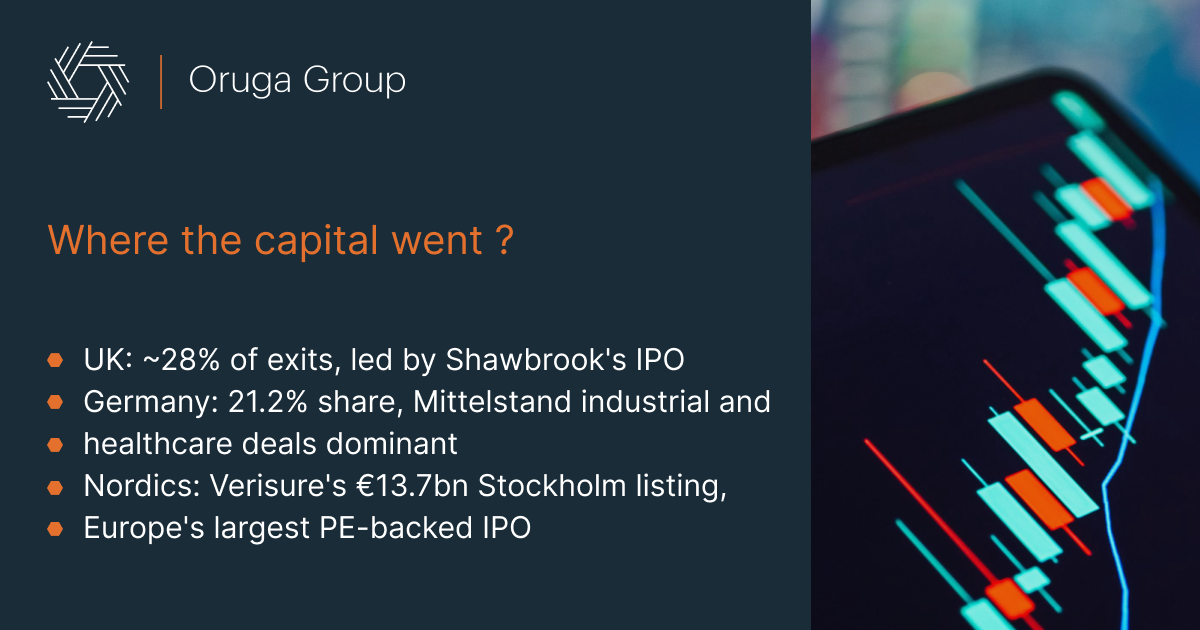
The Nordic region, and Stockholm specifically, produced the year's most consequential single transaction: the Verisure IPO on Nasdaq Stockholm on 8 October 2025. At €13.7 billion in market capitalization, it was Europe's largest PE-backed listing in history and the largest Swedish IPO in 25 years. Hellman & Friedman, which first acquired a stake in Verisure from EQT in 2011 and consolidated full ownership in 2015 at an implied enterprise value of €4.7 billion, realized a multiple of approximately 5.7x on that basis — driven by organic subscriber growth to 5.8 million customers across 17 countries. The offering raised €3.2 billion in fresh capital, was multiple times oversubscribed, and drew GIC, Alecta, AMF, and Tredje AP-fonden as cornerstone investors. The transaction demonstrates that European public markets can absorb large-cap PE-backed listings when the underlying business, subscription-based, 10.3% revenue growth, 45% adjusted EBITDA margin, is truly exceptional.
France contributed the year's most structurally complex large-cap carve-out: CD&R's acquisition of a 50% controlling stake in Opella, formerly Sanofi's consumer health division, which closed on 30 April 2025 with Sanofi receiving net cash of €10.7 billion against an enterprise value of approximately €16 billion. With Bpifrance holding 1.8% as a political concession to French concerns about the sale of a consumer health champion to a US acquirer, Opella's brands include Doliprane, Allegra, and Dulcolax, the transaction crystallises the tension between industrial policy and open capital markets that will continue to characterize large-cap French PE activity.
3. The sector concentration that explains the multiples
Sector allocation in European PE 2025 was sharply concentrated, and the concentration is not random.
Technology and software remained the dominant sector by deal value, a position held consistently since 2019, with software assets commanding EV/EBITDA multiples of 20x or above. The premium reflects conviction in recurring revenue visibility, negative working capital characteristics, strong gross margins, and the AI-driven upsell opportunity embedded in established SaaS platforms. EQT's take-private of Fortnox at $4.5 billion, the largest Nordic buyout of 2025, and Goldman Sachs Alternatives' acquisition of Trackunit, the Danish construction SaaS and IoT platform, from Hg and GRO Capital at $1.4 billion are representative: both involve dominant European SaaS platforms with defensible ARR and international expansion headroom. Thoma Bravo's establishment of a dedicated European fund at €1.8 billion and the opening of a London office formalizes the US software specialist's European ambitions and signals that US software PE playbooks are being directly transplanted into European mid-market SaaS.
Healthcare and life sciences gained three percentage points of market share versus the five-year average in H1 2025. The demographic thesis is durable, European aging populations underpin long-duration return expectations across pharma services, healthcare IT, and consumer health platforms, and KKR's acquisition of Karo Healthcare from EQT at over €2.5 billion in April 2025 is its most direct mid-market expression. Industrials showed the strongest deal count acceleration, up 12% year-to-date through Q3, driven by chemical-related transactions and the energy transition, with TICC (testing, inspection, certification, and compliance) attracting above-average PE attention for its contractually defensive, recurring-revenue profile. Solar became the largest source of EU electricity in June 2025, and the EU's 54% emissions reduction target by 2030 represents a sustained structural demand driver that PE sponsors have correctly identified as a multi-decade investment theme.
4. The regulatory environment as a deal execution variable
For managers operating across Europe, the regulatory framework in 2025–2026 is not background context, it is a variable that directly affects deal timelines, fund structures, and LP composition decisions.
AIFMD II (Directive (EU) 2024/927) requires transposition by 16 April 2026. As of early 2026, Germany, Luxembourg, the Netherlands, and Ireland have published draft implementing legislation or advanced consultations; France, Belgium, Italy, and Spain have not transposed. The practical consequence is a multi-speed regulatory environment in which the choice of fund domicile carries direct compliance implications. Luxembourg reinforces its position as the dominant domicile for EU-focused vehicles. The depositary passport, one of AIFMD II's principal practical benefits for large managers, allows AIFMs to appoint a depositary from a different member state, reducing the operational constraint that previously required co-location. The UK's divergent approach, proposing three new manager categories (Large: above £5 billion NAV; Mid-sized: £100 million to £5 billion; Small), reinforces the progressive regulatory divergence between EU and UK frameworks that cross-border managers must now accommodate structurally.
The EU Foreign Subsidies Regulation has become a structural feature of European M&A execution. Over 200 mandatory FSR notifications have been submitted to the European Commission since July 2023, three times the volume initially projected, with approximately one in three notifications involving a PE buyer. The compliance burden is disproportionate for funds with sovereign wealth fund, state pension, or state-owned bank LPs, all of whom trigger disclosure obligations regardless of whether genuine distortive subsidies exist. The Commission published formal FSR Guidelines on 9 January 2026, confirming broad call-in powers for below-threshold transactions in strategic sectors. Only two Phase 2 investigations have been opened from over 200 filings, confirming that the burden is primarily procedural rather than substantive — but procedural burden alone is materially extending deal timelines and creating “procedural nightmares” for complex cross-border transactions.
ELTIF 2.0's liberalization, in force since January 2024, is producing real but uneven results. EQT's launch of the EQT Nexus PE ELTIF in Q3 2025 and Ardian's launch of three evergreen products under the Ardian Access series are the leading-edge implementations. Private wealth capital represented 22% of Ardian ASF IX's fundraise, up from 11% in the prior vintage, a structural shift in LP composition that will gather pace as ELTIF distribution infrastructure develops in domestic wealth management channels. The Commission's December 2025 Q&A guidance, confirming that member states may not impose nationality or domicile requirements on ELTIFs or their managers beyond the Regulation's own terms, removes a significant fragmentation risk for cross-border ELTIF distribution.
5. What the forward picture requires from practitioners
The 2025 record does not indicate a market in straightforward recovery. Several structural pressures require considered management.
Exit pressure is the most immediate constraint. Average holding periods of 5.3 years, combined with the 2021–22 vintage backlog representing the largest-ever inventory of aged PE assets, will intensify LP pressure for distributions through 2026. IPO markets remain selective, the Verisure listing was exceptional, and PE-backed European IPO exit value as a category fell in 2025 despite it. Sponsor-to-sponsor transactions face mutual valuation disagreements; strategic buyers, though accounting for 45% of exits over the past three years including strong US strategic activity leveraging a favorable dollar, remain opportunistic rather than systematic. The instruments GPs are deploying in response, NAV lending, dividend recapitalizations, continuation vehicles, and partial stake sales, all deliver partial liquidity, but each involves governance implications that LPAs executed in prior vintages may not adequately address. LPs committed to 2021–22 vintage funds should review their fund documents against current GP conduct before distribution patterns deteriorate further.
On the financing side, the 2026-27 European leveraged loan maturity wall from LBOs originated in 2021-22 requires close monitoring. Unitranche margins have compressed toward approximately 500 basis points over base rates from the 2022–23 peak of 500–575 basis points, a function of BSL market recovery and direct lending competition, but credits with deteriorated fundamentals, particularly in healthcare and consumer discretionary, face refinancing stress that may surface as distressed opportunity or portfolio impairment depending on positioning. European equity contributions now stand at 45%-55% of purchase price, materially above the pre-2022 norm of 35%-40%, which provides structural downside protection but constrains levered return profiles in a market where top-quartile buyout IRRs of approximately 8% barely clear the standard 8% hurdle rate.
The AI investment theme, with €150 billion earmarked across more than 20 leading capital allocators for European opportunities over five years, represents both structural opportunity and valuation risk. Eighty-eight percent of PE executives surveyed by PwC in 2025 use AI to appraise investments, and 65% use it for due diligence. Internal AI adoption is outpacing considered sector specialization in many portfolios. Managers who close that gap with defined AI sector theses, rather than treating AI as a generalist overlay applied to otherwise conventional underwriting, will demonstrate differentiated sourcing and conviction that LPs increasingly require before committing to new vehicles.
Frequently Asked Questions
What drove the disparity between European deal count and deal value in 2025?
The divergence reflects megadeal concentration. Global deal count fell modestly to approximately 34,300 from 36,500 in the prior year while transaction value reached approximately $2 trillion, the second time that threshold has been crossed. Within Europe, the top 10 PE buyouts accounted for 12% of total European deal value. Add-on acquisitions, which require smaller capital deployments, represented approximately 56% of European PE deals by count, inflating deal count while compressing average deal size. The market's structural architecture in 2025 was a small number of very large US-led platform transactions sitting atop a high volume of smaller bolt-on deals, with the two layers reflecting fundamentally different dynamics: megadeal execution by US sponsors capitalizing on European valuation discounts, and bolt-on activity by existing sponsors managing portfolio companies during an extended hold period.
How does the EU Foreign Subsidies Regulation affect a PE fund with sovereign wealth fund LPs on a European acquisition?
FSR notification obligations are triggered when the target has EU turnover exceeding €500 million and the parties have received foreign financial contributions (FFCs) exceeding €50 million in the three prior years. The FFC definition is broad, covering any financial flow from a non-EU government entity, including equity from sovereign funds, loans from state-owned banks, and government contracts. A PE fund with SWF or state pension LPs is therefore directly in scope for FSR analysis on qualifying transactions. The Commission's January 2026 FSR Guidelines confirm that an AIFM carve-out limits disclosure obligations to the acquiring fund level rather than requiring LP-level disclosure, but specific conditions apply and must be assessed with counsel. The practical timeline consequence is an additional review process running in parallel with EU merger control and any applicable national FDI reviews, with the Commission having 25 working days for Phase 1 extendable to 90 days in Phase 2. LP mapping for sovereign-connected investors should be completed during exclusivity negotiation rather than post-signing.
Is an ELTIF 2.0 structure the right access route for a family office seeking European PE exposure?
ELTIFs registered under ELTIF 2.0 offer EU passport distribution, access to established PE manager pipelines at reduced minimum thresholds, and improved liquidity provisions compared with traditional closed-end AIF structures. For family offices with direct access to institutional fund co-investments at competitive economics, the ELTIF's qualifying asset restrictions, mandatory liquidity management tools, and regulatory overlay may not represent the optimal access route. For family offices requiring a regulated, distributable product, particularly in jurisdictions where direct fund investment requires professional investor classification, ELTIF structures from established managers with demonstrated track records merit evaluation. The Ardian Access series and EQT Nexus PE ELTIF are among the earliest institutional-quality implementations; both target professional private investors with access to the same transaction pipeline as major institutional LPs, representing a structural improvement over the prior generation of retail-wrapper PE products.
What do extended hold periods mean practically for LPs committed to 2021–22 vintage European funds?
LPs committed to 2021-22 vintage funds are receiving materially lower distributions (DPI) than historical comparisons suggest. Total value (TVPI) metrics may appear reasonable on paper while cash returns are significantly delayed. The instruments GPs are deploying to address this involve distinct risk profiles. NAV lending increases fund-level leverage and may fund distributions from debt rather than realized gains, impairing LP returns disproportionately if the portfolio deteriorates. Dividend recapitalizations increase portfolio company leverage, reducing financial headroom. Continuation vehicles require LPAC consent and involve the GP acting simultaneously as an effective buyer and seller, creating a conflict of interest that requires an independent fairness opinion and transparent LP governance. LPs should review their LPAs against current GP conduct to assess whether consent rights are being properly observed, and should model the DPI impact of each proposed liquidity mechanism before accepting it as a substitute for genuine exit proceeds.
How does AIFMD II affect non-EU GPs raising capital from European institutional investors?
AIFMD II applies a subset of requirements to non-EU managers, and the precise scope depends on the implementation choices of individual member states, which are themselves in different stages of transposition. Non-EU GPs using third-party EU AIFMs as the regulatory wrapper for a European strategy should engage immediately with those AIFMs to understand their compliance approach, particularly on delegation rules, liquidity management tools, and depositary arrangements, as these decisions will affect fund documentation, investor reporting obligations, and operational costs. The UK's divergent AIFMD review, proposing three new manager categories and reviewing leverage, remuneration, and capital rules, adds structural complexity for marketing managers across the UK/EU border. Managers who have not yet assessed the jurisdictional implications of the April 2026 transposition deadline, including which member states will and will not have transposed by that date, should treat this as an immediate compliance priority.
What is the investment case for European industrials, and which sub-sectors command the highest PE conviction?
European industrials attracted the strongest deal count acceleration of any sector in 2025, up 12% year-to-date through Q3. The investment case rests on two structural drivers. First, the energy transition: solar became the largest source of EU electricity in June 2025, the EU is tracking toward a 54% emissions reduction target by 2030, and distribution grid modernization is described by energy infrastructure operators as the backbone of that transition. Second, the Mittelstand modernization imperative in Germany and DACH, where family-owned industrial firms face competitive pressure from Chinese manufacturers and require capital for energy transition, digitization, and international distribution. Within industrials, TICC, testing, inspection, certification, and compliance, commands the highest PE conviction, combining contractually defensive recurring revenues with service exposure to both manufacturing clients and the expanding regulatory compliance requirements of the energy transition sector. Carve-outs of undervalued corporate divisions, exemplified by Advent International's $4.8 billion acquisition of Reckitt Benckiser's Essential Home business, offer additional entry routes where listed parent company valuations understate the standalone value of industrial subsidiaries.
This article is for general information purposes only and does not constitute legal, tax, investment, or regulatory advice. The analysis reflects publicly available information as at May 2026. Regulatory developments are evolving rapidly. Readers should seek qualified legal, financial, and regulatory advice in the relevant jurisdictions before making any investment, structural, or compliance decisions.